
Dec
23
23
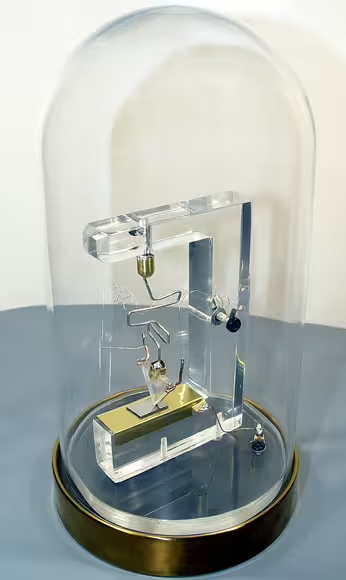
On December 23, 1947, physicists John Bardeen and Walter Brattain demonstrated a working point-contact transistor to senior staff at Bell Laboratories in New Jersey. Their small experimental device could amplify an electrical signal using a semiconductor. It marked a decisive step towards the compact electronics that would reshape communications and computing.
A Breakthrough Before Christmas
The demonstration followed a successful experiment on December 16. Bardeen and Brattain had been investigating how electrical behaviour at a semiconductor’s surface affected its ability to control current.
Their work took place within a research group led by William Shockley. Bell Labs was seeking alternatives to the vacuum tubes used in electronic equipment, including the telephone network. A reliable semiconductor amplifier offered the prospect of smaller devices with lower power requirements.
Gold Contacts and a Piece of Germanium
The first transistor looked very different from a modern computer chip. It consisted of a small piece of germanium and two closely spaced gold contacts held against its surface by a plastic wedge.
A small electrical change at one contact could control a larger change in current at the other. This produced amplification: a weak input signal could influence a stronger output signal. The arrangement demonstrated that a solid semiconductor could perform a task previously associated with vacuum tubes.
Three Scientists, Different Contributions
Bardeen contributed theoretical insight, while Brattain brought experimental expertise to the device they demonstrated. Shockley subsequently developed the concept of the junction transistor, offering a more robust approach than the delicate point-contact arrangement.
Bell Labs publicly announced the transistor on June 30, 1948. In 1956, Bardeen, Brattain and Shockley shared the Nobel Prize in Physics for their semiconductor research and discovery of the transistor effect.
From a Laboratory Device to Everyday Technology
The transformation took years of further research and manufacturing improvements. Transistors entered hearing aids, radios, telephone equipment and computers. Their ability to amplify signals and operate as electronic switches made them useful across many different applications.
Later developments allowed large numbers of transistors to be combined in integrated circuits. The apparatus demonstrated before Christmas in 1947 was far removed from those miniature chips, but it established a principle that became fundamental to modern electronics.
Other Events on This Day
- Alain Bombard Reaches Barbados After an Extraordinary Atlantic Survival Experiment
- Chet Baker Is Born, a Distinctive Trumpet Player and Voice of Cool Jazz
Credits: 1st photo: Mister rf, 2019, via Wikimedia Commons, licensed under CC BY-SA 4.0. Sources: Computer History Museum — 1947: Invention of the Point-Contact Transistor; Computer History Museum — Inventing the Transistor; The Nobel Prize — The Nobel Prize in Physics 1956


