Sep
4
4
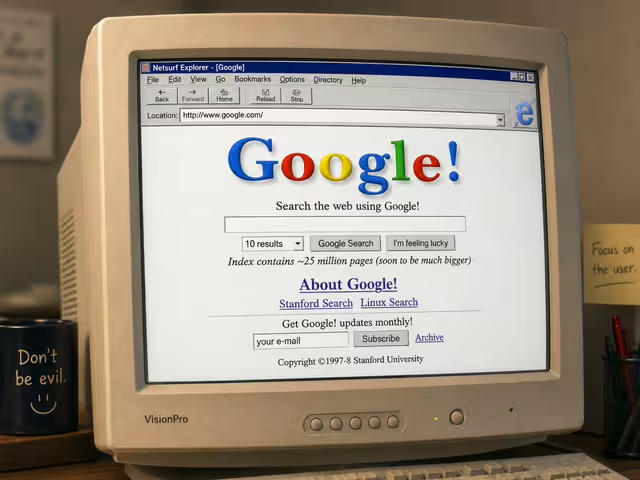
On September 4, 1998, Larry Page and Sergey Brin officially founded Google. What began as a university research project would grow into one of the most influential technology companies in the world and transform the way people search for information online.
At the time, both founders were doctoral students at Stanford University in California.
A Search Engine Born at Stanford
Google did not begin as a company.
It started as a research project created by Larry Page and Sergey Brin while they were studying computer science at Stanford.
Their goal was to find a better way to organize the rapidly growing World Wide Web.
Existing search engines often relied heavily on how frequently certain words appeared on a page.
A Different Way to Rank the Web
Page and Brin focused instead on the links connecting websites.
Their idea was that a page could be considered more important if many other important pages linked to it.
This approach became the foundation of an algorithm known as PageRank.
The name referred both to web pages and to Larry Page himself.
Before Google, There Was BackRub
The early search engine had an unusual name: BackRub.
The name reflected the system's analysis of backlinks — links pointing from one website to another.
As the project developed, Page and Brin decided they needed a better name for a search engine intended to organize enormous amounts of information.
Where the Name Google Came From
The name Google was inspired by the mathematical term googol.
A googol is the number 1 followed by 100 zeros.
The enormous number reflected the founders' ambition to organize an almost unimaginably large amount of information.
The spelling “Google” became the name of the new search engine and eventually one of the world's most recognizable technology brands.
A $100,000 Check
One of the most famous moments in Google's early history came before the company legally existed.
Andy Bechtolsheim, a co-founder of Sun Microsystems, saw a demonstration of the search technology and was impressed.
He wrote Page and Brin a check for $100,000 made out to “Google Inc.”
There was only one problem: Google Inc. had not yet been incorporated.
Google Becomes a Company
On September 4, 1998, Google was officially incorporated.
The university research project had now become a real company.
The founders soon began building the business around their search technology and attracting additional investment.
The Famous Garage
Google's early operations soon moved into a garage in Menlo Park, California.
The garage belonged to Susan Wojcicki, who rented the space to the young company.
She later joined Google and became one of its most important executives, eventually serving for many years as CEO of YouTube.
The garage became part of Google's startup mythology, although the core search technology had already been developed at Stanford.
A Cleaner Search Experience
Google also stood out because of its unusually simple design.
While many websites of the late 1990s were filled with banners, menus, advertisements, and crowded pages, Google's homepage was remarkably minimal.
A logo, a search box, and a few buttons were enough.
The simplicity reinforced the idea that search itself was the product.
Finding Information Faster
As the web expanded, Google's ability to return relevant results quickly attracted more users.
The company continued improving its search algorithms and building massive computing infrastructure to index an ever-growing number of websites.
Searching the internet gradually became one of the most common activities performed online.
From Search Engine to Technology Giant
Google eventually expanded far beyond web search.
The company developed or acquired services in email, online maps, mobile operating systems, video, cloud computing, artificial intelligence, web browsers, and digital advertising.
Products such as Gmail, Google Maps, Android, Chrome, and YouTube became part of everyday digital life for billions of people.
A Brand That Became a Verb
Google became so closely associated with internet search that its name entered everyday language.
The verb “to google” came to mean searching for information on the internet.
Few company names become so deeply connected with the activity their product performs.
Organizing the World's Information
Google's early mission was famously described as organizing the world's information and making it universally accessible and useful.
That goal reflected the problem Page and Brin had originally tried to solve as graduate students: how to make sense of an internet that was growing faster every year.
From University Project to Global Company
On September 4, 1998, Larry Page and Sergey Brin turned their Stanford research project into a company called Google.
They could not have known how deeply their search engine would influence communication, education, business, science, and everyday life.
What began with two students trying to rank web pages more intelligently became one of the defining technology stories of the internet age.
Other Events on This Day
- George Eastman Patents the Kodak Camera and Changes Photography Forever
- Mark Spitz Makes Olympic History With Seven Gold Medals