
Oct
31
31
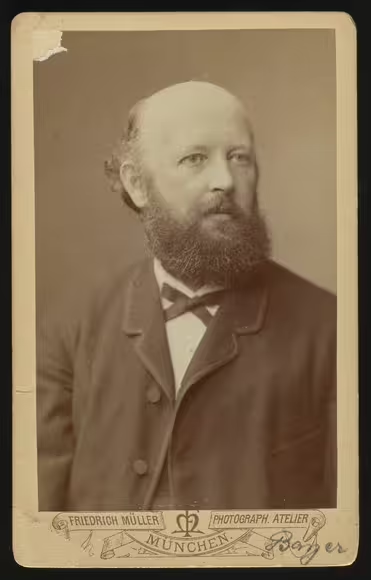
On October 31, 1835, German chemist Adolf von Baeyer was born in Berlin. His investigations into organic compounds, particularly dyes, helped connect laboratory research with the growing chemical industry. In 1905, his contributions earned him the Nobel Prize in Chemistry.
A Career Built on Experiment
Baeyer initially studied mathematics and physics before turning to chemistry. He worked with Robert Bunsen and August Kekulé, two influential figures in nineteenth-century science, and completed his doctorate in 1858.
His academic career eventually brought him to the University of Munich, where he became professor of chemistry in 1875. Teaching and experimental research remained closely connected throughout his work, as he investigated how organic substances could be understood and prepared in the laboratory.
The Challenge of Making Indigo
Among Baeyer's most important achievements was the synthesis of indigo, the blue dye traditionally obtained from plants. Reproducing such a valuable natural substance through chemical reactions presented both a scientific challenge and a potential opportunity for textile manufacturing.
Baeyer's laboratory successes helped establish that indigo could be made synthetically. However, preparing a substance in an experiment was different from producing it economically on an industrial scale. Further research by other chemists and manufacturers was needed before synthetic indigo became a commercial product.
In 1897, BASF launched its industrially produced synthetic indigo after years of development. The story illustrates how a scientific breakthrough can provide a foundation for industrial progress without immediately delivering a practical manufacturing process.
Recognition Beyond a Single Dye
Baeyer's research extended beyond indigo. He also investigated other organic compounds, including barbituric acid, which he first prepared in 1864.
The Nobel Prize recognised the wider importance of his work on organic dyes and hydroaromatic compounds. His career demonstrated how studying the structure and behaviour of molecules could advance fundamental chemistry while opening possibilities for new materials and methods of production.
Other Events on This Day
- Alexander Alekhine Is Born, the Future World Chess Champion and Influential Chess Author
- Satoshi Nakamoto Introduces Bitcoin in a Nine-Page White Paper
Credits: 1st photo: Friedrich Muller / Courtesy of Science History Institute, Williams Haynes Portrait Collection. Public domain. Sources: NobelPrize.org — The Nobel Prize in Chemistry 1905; Science History Institute — Portrait and Biography of Adolf von Baeyer; The Royal Society — Adolf von Baeyer; BASF — History, 1865–1901


