
Oct
22
22
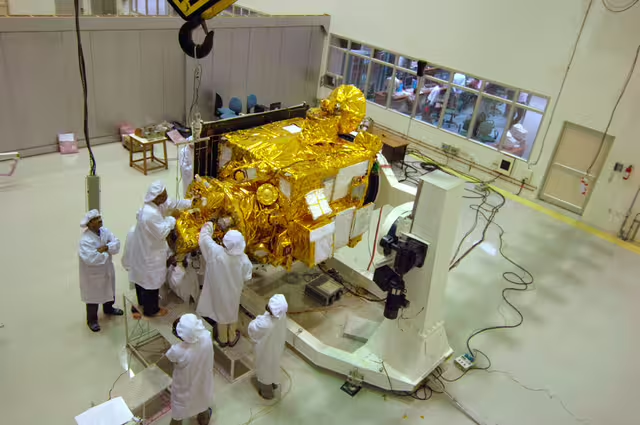
On October 22, 2008, India launched Chandrayaan-1, its first mission to the Moon. Carried into space by a PSLV-C11 rocket from Sriharikota, the spacecraft began a scientific journey that would help change our understanding of Earth’s nearest celestial neighbour.
Mapping the Moon from Orbit
Developed by the Indian Space Research Organisation (ISRO), Chandrayaan-1 carried eleven scientific instruments built in India and several other countries. Its mission was to examine the Moon’s surface, map its terrain and investigate its chemical and mineral composition.
The spacecraft studied the Moon from an orbit approximately 100 kilometres above the surface, later raised to 200 kilometres. Its instruments provided complementary views of a landscape whose familiar appearance concealed many unanswered scientific questions.
A Discovery Written in Reflected Light
One of the mission’s most important contributions came from NASA’s Moon Mineralogy Mapper, known as M3. By analysing infrared light reflected from the lunar surface, the instrument detected absorption patterns associated with water molecules and hydroxyl, a chemical group containing oxygen and hydrogen.
Announced in September 2009, the findings revealed small quantities of these substances interacting with lunar rock and dust. The signatures were particularly strong at higher latitudes. Observations from the Cassini and EPOXI missions supported the discovery, strengthening the evidence through independent measurements.
This was molecular evidence within the Moon’s surface material, rather than the discovery of lakes or flowing water. Even in small quantities, it opened new questions about how water forms, moves and survives on the Moon.
A Short Mission with Lasting Results
Communication with Chandrayaan-1 was lost on August 29, 2009, after more than 3,400 lunar orbits. Although its operations ended earlier than planned, the mission had gathered valuable scientific data.
Its launch marked an important step in India’s exploration of space, while its discoveries demonstrated the value of international cooperation in understanding the Moon.
Other Events on This Day
- André-Jacques Garnerin Makes the First Recorded Parachute Descent from a Balloon
- Ivan Bunin Is Born — The Poet and Storyteller Who Became Russia’s First Nobel Laureate in Literature
Credits: 1st photo: Photo: Indian Space Research Organisation (ISRO), 2008, via Wikimedia Commons. Licensed under the Government Open Data License – India (GODL-India). Sources: ISRO — Chandrayaan-1; NASA Jet Propulsion Laboratory — NASA Instruments Reveal Water Molecules on Lunar Surface


