
Oct
20
20
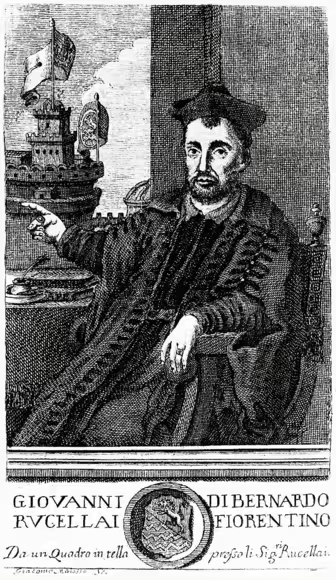
On October 20, 1475, Giovanni di Bernardo Rucellai was born in Florence. A poet, playwright and humanist, he belonged to a generation of Italian writers who looked to ancient literature for inspiration while exploring the possibilities of their own language.
Growing Up in Renaissance Florence
Rucellai came from a family closely connected with Florence’s intellectual life. His father, Bernardo, was a humanist, while his mother, Nannina de’ Medici, was the sister of Lorenzo the Magnificent.
His education included study under the philosopher Francesco Cattani da Diacceto. This grounding in classical culture helped shape a literary career that brought together poetry, drama and the Renaissance enthusiasm for Greek and Roman authors.
Giving Classical Tragedy an Italian Voice
Rucellai’s Rosmunda, completed by early 1516, belongs among the earliest Italian Renaissance tragedies modelled on classical drama. Its story draws on Lombard history, while elements of its treatment recall Sophocles’ Antigone.
Another dramatic work, Oreste, took inspiration from Euripides’ Iphigenia among the Taurians. Through these plays, Rucellai participated in the effort to adapt ancient theatrical forms for readers and audiences using Italian.
The Poetry of Bees
His most enduring literary reputation rests on Le api, or The Bees, published after his death in 1539. Written in unrhymed eleven-syllable lines, the poem drew on the fourth book of Virgil’s Georgics, which concerns beekeeping.
Rucellai enriched this classical model with observations of beehives at his family’s villa near Florence. The result joined practical subject matter with carefully crafted verse, turning the activity of bees into material for poetry.
Rucellai died in Rome in 1525. His works preserve a distinctive aspect of Renaissance literature: the desire to learn from antiquity while finding fresh expression in the language and natural world close at hand.
Other Events on This Day
Credits: 1st photo: Giacomo Malosso, nineteenth-century engraving, after a painting in the Rucellai family collection. Via Wikimedia Commons. Public domain. Sources: Treccani — Giovanni Rucellai, Dizionario Biografico degli Italiani; Treccani — Giovanni Rucellai, Enciclopedia Italiana


